

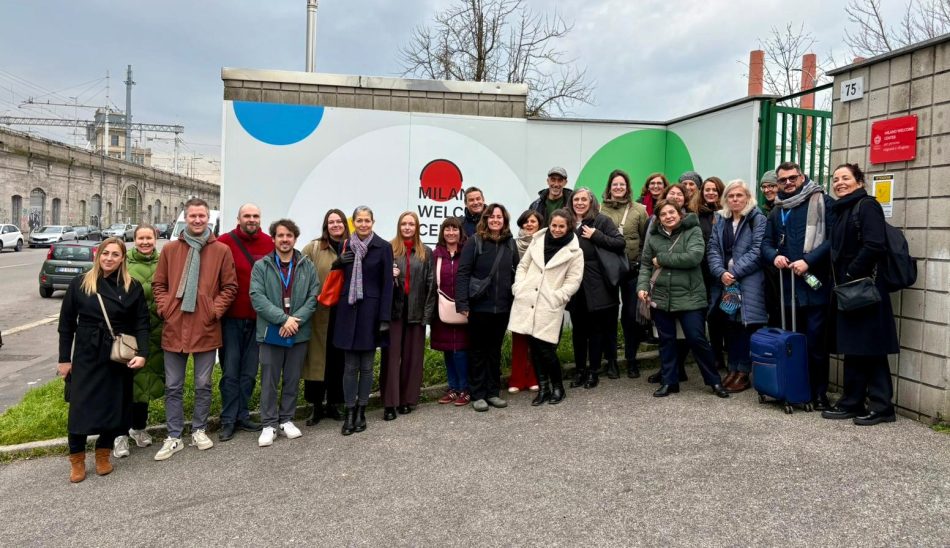
At the end of January, the RRF organised a two-day field visit to Milan (Italy) in the framework of the Support to Frontline Workers project. The visit brought together practitioners and government representatives, from Belgium, Denmark, Germany, Ireland, Italy, Luxembourg, Spain, and Switzerland, to explore local approaches to irregular migration and multilevel collaboration as means to reach the target group and manage their migration trajectories.
Milan was selected as a learning location due to its long-standing experience in integrated service provision, structured co-design methodology, and established practices of multi-level collaboration. The exchange highlighted how a well-developed one-stop-desk approach and strong horizontal cooperation among local actors – involving more than 40 civil society organisations – support holistic case management and coordinated outreach efforts for people in vulnerable situations, contributing to rights-based pathways, including voluntary return.
Participants explored these approaches through exchanges with representatives at municipal, regional, and national levels, as well as site visits to frontline services. These included the Milano Welcome Center alongside meetings with civil society organisations and their mobile outreach teams on municipal level, ANCI on the regional, the Ministry of Interior on the national, with deep dives into LGNet3 project for focused support for a vulnerable category of migrants in secondary movement and IOM’s “RI.VOL.ARE IN RE.TE” project for AVRR focal points.
Particular attention was given to governance arrangements, funding mechanisms, and coordination across institutional levels. Participants reflected on the opportunities and complexities inherent in multi-level collaboration, noting the importance of continuous dialogue and alignment between national frameworks and local implementation. The exchange provided a space to jointly reflect on how communication and information flows across levels can be further strengthened to support effective operational practice.
A good practice identified as particularly relevant for sharing with other EU contexts was Milan’s co-planning and co-design methodology, a technical tool for collaborative project design and policy implementation. This approach supports aligned service delivery, shared responsibility among actors, and trust-based cooperation. It will be shared during a following online forum and uploaded on RRF’s SFW repository (closed space).
The learnings from the Milan exchange will contribute to a forthcoming policy brief on multi-level collaboration for outreach to migrants in irregular situations in Europe, supporting the SFW project’s objective of strengthening practitioner-informed and evidence-based approaches across the EU.