

The Support to Frontline Workers (SFW) project has concluded with a set of public resources and a policy brief capturing lessons from peer-to-peer exchanges in Bilbao, Milan and Malta.
Building on the learnings of the Reaching Undocumented Migrants (RUM) project, as well as the heritage of the Reach Out 1.0 and 2.0 projects under the ERRIN programme, the SFW cycle responded to partners’ request for practical exchange among frontline workers, return counsellors, civil society organisations, municipalities and national authorities. The project focused on how outreach, counselling and Assisted Voluntary Return (AVR)-related support can reach migrants in irregular or vulnerable situations, particularly those who are outside, or only partially connected to, formal systems.
At the centre of the project were three exchange visits. Each visit offered a different perspective on how governance design shapes frontline work.
- In Bilbao, participants explored a rights-based, locally anchored approach built around municipal registration, one-stop access, intercultural mediation, inclusion, diaspora organisations and dynamic but structured Basque and Bilbao governance networks. The visit showed how trusted local entry points and a shared strategic narrative can help connect people to services and longer-term pathways.
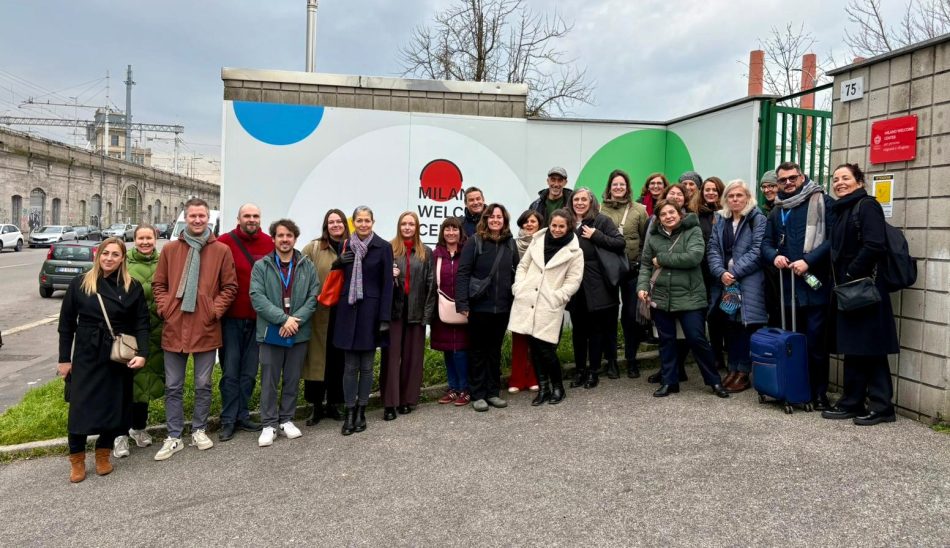
- In Milan, the focus was on co-design as a governance tool for frontline collaboration. Through the Milano Welcome Center and wider municipal service ecosystem, participants examined how public authorities and civil society can share planning and implementation responsibilities, supported by a national framework. The visit highlighted how legal, social, employment and AVR counselling can be embedded in broader case management, rather than treated as separate interventions.
- In Malta, participants examined a centralised operational model, where asylum procedures, return counselling and AVR are closely linked within national institutions. The visit highlighted the advantages of early and continuous counselling, close institutional coordination and clear procedural pathways.
Together, the three visits demonstrated that effective outreach and counselling depend not only on procedures, but on how services are connected in practice. They also showed that stabilisation can be understood as part of case resolution, not as a delay. Migrants need accessible entry points into support systems, while frontline workers need clear roles, referral pathways, trusted partners and feedback channels into policy.
These findings are now brought together in the policy brief Beyond Procedures: How Multi-Level Governance Shapes Outreach and Assisted Voluntary Return Counselling at the Local Level.
A wider European professional audience was reached through online forums and follow-up discussions. These exchanges created space for practitioners and policymakers to reflect on one-stop access models, co-design, community-based outreach, early counselling and multi-level coordination.
The project was formally wrapped up during an online closing session on 27 May, where participants from 13 EU+ countries actively reflected on the key learnings and were introduced to the policy brief.
As Member States start to implement the Pact on Migration and Asylum, the SFW project offers timely lessons for national and local authorities. Its findings underline that outreach and AVR counselling should not be designed as stand-alone interventions. They require systematic multi-level governance and frontline collaboration.
RRF thanks all participants, hosts and partners involved in the SFW exchange visits, forums and follow-up discussions for their expertise and active engagement throughout the project.